

E-books and e-readers are so deeply ingrained in our culture and daily lives, it’s hard to imagine a time without them.
Not long ago in 2007, Amazon released the Kindle and ushered in a reading revolution. Since then, Amazon has sold 487 million Kindle books and redefined the publishing industry with Amazon Kindle Direct Publishing (KDP).
Millions have turned to KDP to self-publish their books, creating a tidal wave self-publishing industry worth $1.25 billion in sales. In just the last five years alone, the number of self-published books has increased by 264%.
Billions of dollars have been made in this industry since its inception, yet there has been no way to make a dollar of that money without direct ownership of a KDP business – until now.
After years of witnessing KDP’s steadily growing tailwinds from an online business M&A perspective, we wanted to give investors their first-ever opportunity to fractionally invest in KDP businesses.
Our first KDP-focused investment fund, Fund 8010 run by Portfolio Manager Andy Fernandez, has brought in 18.1% returns in its first year of operation. We’ve interviewed Andy to share his behind-the-scenes experience and explain in his own words how he structured deals that would maximize returns for investors.
Let’s explore how and why KDP has developed into a force of nature for investor cash flow, and why this space will be one to pay attention to.
What is KDP?
Kindle Direct Publishing (KDP) enables self-published authors to sell their books to Amazon’s extensive market without having to rely on traditional publishing companies.
It’s been a game changer for authors because they can benefit from full rights to their books (previously near impossible to achieve with a traditional publishing house) as well as quickly and simply publish ebooks and paperback books without upfront inventory costs. Authors are able to publish and see what sells to an audience with low risk as Amazon only takes fees when a sale is made.
The power of KDP for self-publishers doesn’t just lie in being free from strenuous publishing contracts or inventory creation; it’s the incredible global market potential of Amazon.
Amazon KDP is a world market leader for books, e-books, and self-published works. In the last few years, Amazon has expanded print book availability to Australia, Japan, and the Netherlands, with the potential to expand to more markets in the near future.
While there is great potential in tapping into global demand, most e-book statistics report the US leads the global market in e-book consumption. According to the Association of American Publishers, the US book industry generated $1.3 billion in revenue at the start of 2023.
Amazon KDP is the main vein of the booming paperback and e-book industry; a strong current that holds a majority of the world’s book market share.
KDP business owners have thus tapped into the world’s main source of book revenue, and one of the most underrated online asset opportunities in the industry.
The Investing Potential of KDP Assets
Scalability is one of the most exciting aspects of KDP.
Authors can publish as many e-books or paperback books as they’d like under one account utilizing different pen names to publish across categories. The ability to create a brand with many writers ghostwriting content under a pen name allows KDP account owners to create their own mini-publishing houses.
Previously, the only way to participate in the KDP industry was to publish books under your own KDP account and either create content yourself or hire writers to create publishable works.
This avenue has worked for plenty of KDP business owners, as once they establish rapport as a KDP publisher they can easily make thousands per month in passive income. But that success doesn’t come without sweat equity, and the risk of being an entrepreneur fully vested financially in the viability of the brand.
That’s what makes the opportunity to fractionally invest in KDP through WebStreet so powerful.
It’s the first-of-its-kind opportunity to participate in the growth of the overall book and e-book industry without having to start an entire KDP business from scratch.
Investors get to invest passively in KDP cash flow while skilled KDP portfolio managers scale the business and investors’ monthly returns.
We’ve witnessed what a strong Portfolio Manager can do with a KDP asset via Fund 8010. Let’s explore how Andy was able to maximize his acquisitions’ performance and what the future may look like for this fund.
Fund Overview
Andy came to us as a Portfolio Manager ready to build off his years of experience in the Amazon space. Since 2010, Andy had been an early FBA adopter, selling on Amazon and eventually exiting his own business.
When Andy found his way to Webstreet in the fall of 2021, he knew that acquiring in the FBA space was fiercely competitive. Amazon Aggregators were swiftly acquiring and driving up multiples, a time period Andy called “aggregator mania”.
Since Andy already owned his own KDP business and understood the inherent potential in the monetization, he decided to double down on KDP assets with the WebStreet fund.
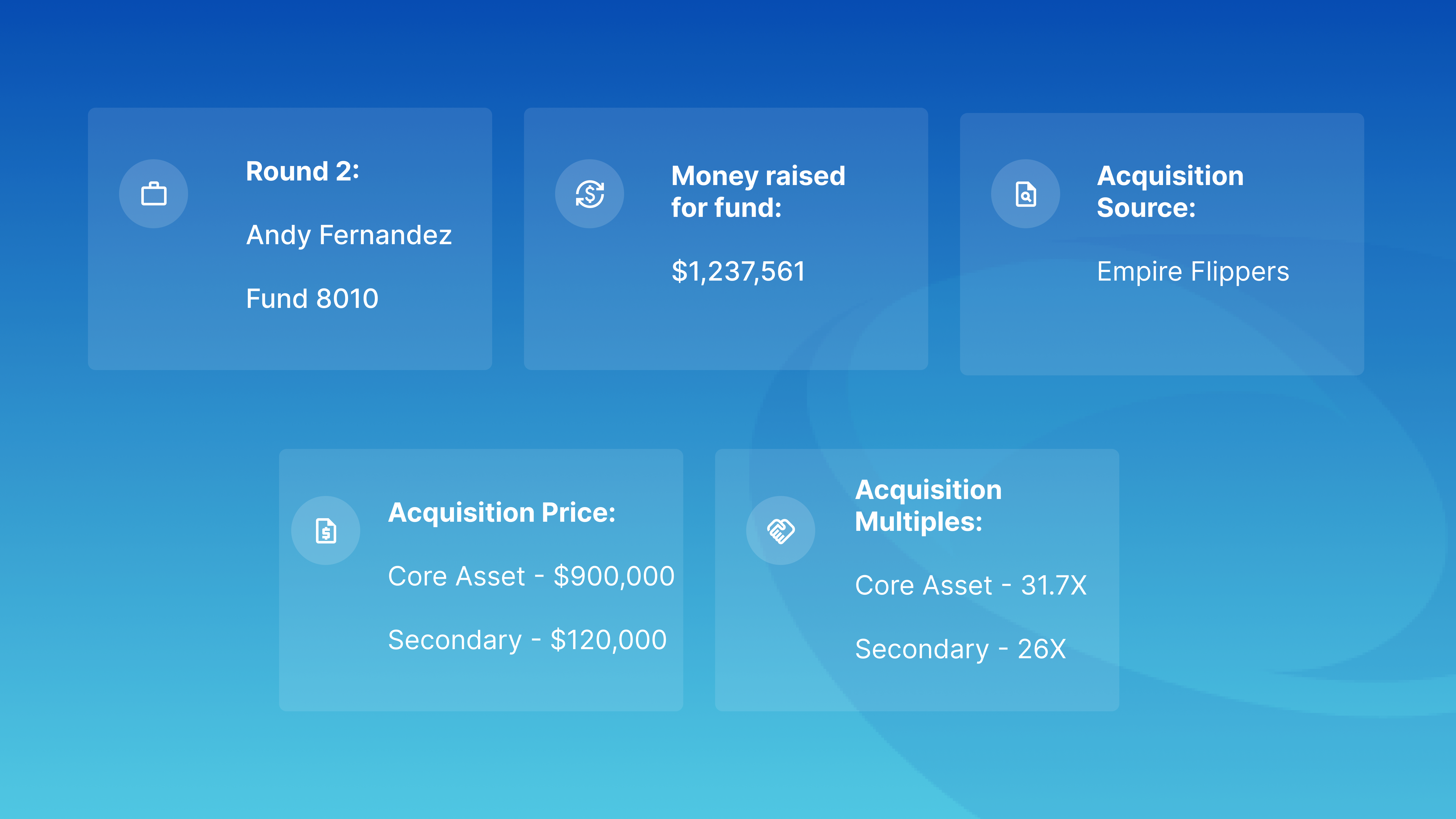
Ultimately, Andy acquired two KDP businesses for Fund 8010: $900K for the core asset and $120K for the secondary asset. Since the acquisition, the businesses have returned 18.1% cash yield for investors within the first year of operations.
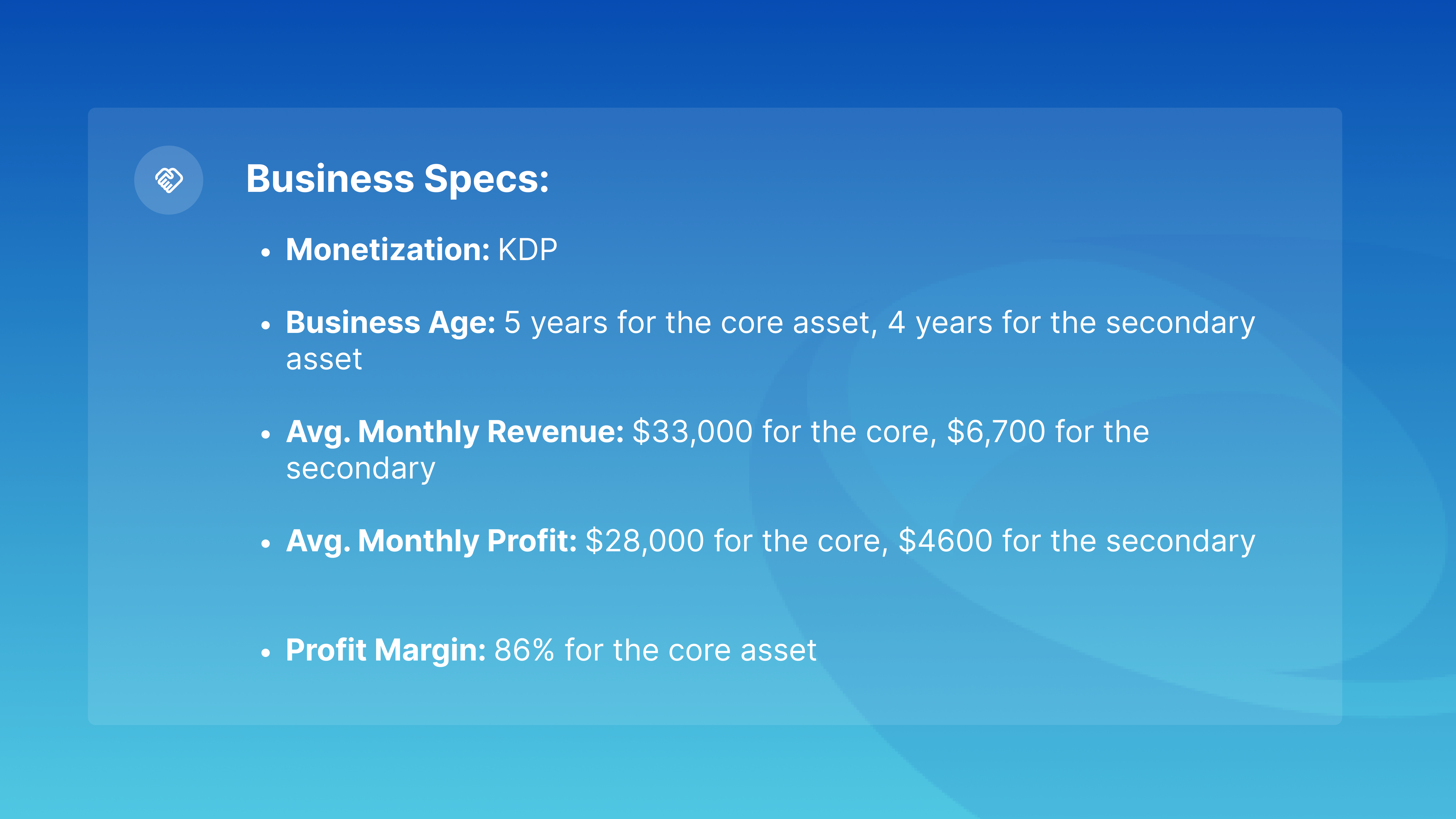
Here’s the core overview of the data surrounding the two successful acquisitions of Fund 8010:
Business Specs
Buying Opportunity
During the acquisition process, Andy sought out KDP businesses with low-hanging fruit for optimization that would poise the business for growth. He also looked for businesses that had a strong foundation and reputation with their audience.
He had a tight list of acquisition criteria that signified a business on an upward trajectory.
These were the criteria he found held the most promise for future growth and indicated a solid KDP business foundation:
Author Brands
Both brands had Author Brands, established pen names you can continuously release new titles under.
Established author personas are harder to find in KDP acquisitions as they’re more difficult to build and establish a following for.
Author brands give the business longevity to continuously build the persona (or the underlying brand behind it).
Author brands typically indicate an established audience; a priceless asset for any business.
Advertising Opportunities
Both businesses’ sellers had little advertising experience and had limited advertising for the brands.
Because Andy had worked as a Senior Marketer for a full-service agency for Amazon brands, he came to the table with deep Amazon advertising experience. He had managed ad spend as high as $100k monthly, so he understood how to properly leverage ads to grow Amazon businesses.
He saw the potential to use smart advertising to grow the KDP assets and knew he could build out an ad strategy that would help scalability.
CRO Potential
Neither asset was using A+ Content, which Andy saw as a quick way to have a large impact on the business’s ability to convey its brand.
Improving the visibility of the brand was a low-hanging opportunity to potentially increase the conversion rates for both businesses.
Low Multiple (for the secondary asset)
The competition for the smaller secondary business was limited. It had been on the market for some time with few bids to buy. Andy knew that this would be a prime opportunity to negotiate a better deal structure and secure the business for a lower multiple.
Low Competition
KDP generally has fewer assets available for acquisition, however, there is also less buying competition in the space.
This was a strong buyer advantage because it allowed Andy to take his time to find the right acquisitions, without worrying about the competition taking the deals he was interested in.
Andy had more time to negotiate and close his deals for both assets. The time to work through the deals was incredibly important as negotiations for the core asset took considerable back and forth.
Negotiations
The negotiation process was run by Andy and a WebStreet acquisition advisor. Each business was identified as an acquisition prospect early on in the 90 day acquisition period. The deals remained ongoing through most of the acquisition window with periods of due diligence and assessing the viability of other deals.
Core-Asset Negotiations
Negotiations were a key part of the process for the core asset because the seller was set on a strong multiple and high sales prices for their business.
Influenced by soaring FBA multiples at the time, the seller expected a price that was in line with the 45-50x that other Amazon-based businesses were getting. When the business was listed on Empire Flippers, it asked for a 45x multiple.
It’s not as if the seller was completely ungrounded in their expectations.
Their business had just experienced a considerable increase in sales and revenue. In its best month during the pandemic holiday season, the business brought in nearly $90,000. But after the holiday rush, the business’ sales came down and Andy recognized that the rise in sales was transitory.
At the time sales began to rise, most schools were shut and students were homeschooled. Thus, the school-related brand nestled under the KDP business was selling academic books at a higher volume to families homeschooling their kids.
During the time of the deal, however, schools had just opened back up and Andy knew that bump in sales wasn’t going to realistically stay.
This is where negotiations became tricky. The seller was adamant that the value of the business should reflect recent performance via a high multiple. Andy knew that this was unsustainable and had to offer another view of the business’s future.
So he went back to the drawing board. Andy decided the best option was to model a new P&L based on a more realistic projection of future sales performance with the knowledge that homeschooling would now decrease. In his words:
“The P&L was inflated. The way we had to go about winning it was to remodel the P&L to show what it would look like, instead of using trailing 12 months, what would the future 12 months look like?”
The tactic worked. With a better projection of the business’s future performance in hand, Andy negotiated the business for a more reasonable multiple. As a part of the deal structure, a stability payment based on that new model was created.
A stability payment helps protect buyers and creates upside for the seller. This payment usually represents 5-10% of the total deal value and is paid out typically after the 12-month mark based on anticipated growth milestones. If the business performs as projected, the seller is paid an extra sum of cash while the buyer gets to benefit from a bit of additional financing during the first year of ownership. Should the business not perform as planned, the buyer has the extra layer of security of not having to pay more for the business.
In this case, the $50,000 set aside as the stability payment allowed Andy to ensure the business could be strong enough to hit its projections. With the stability payment in place, it also allowed him to allocate less capital upfront to get the business for a better sales price.
The deal took considerable back and forth and closed right at the end of the acquisition period. While Andy had other deals he was working on for the place of the core asset he was grateful this deal was the one that came through.
Ultimately, the work it took Andy to restructure the P&L to accurately reflect the performance of the business allowed him to secure the business for a multiple that would reflect its true value and protect the capital investment from the start.
Secondary asset negotiations
Andy and his advisors felt a secondary business would be helpful for the fund so he looked to acquire a smaller, complimentary business in the KDP niche.
He found a deal with low competition and saw an opportunity to make negotiations work in his favor. Since the deal had been listed for some time, he reached out to the seller with an initial lower offer.
After a little back and forth with the seller, Andy was able to secure the business for 26x—a fantastic multiple with solid potential for strong ROI.
Post-Acquisition Growth Strategy
With both assets in tow, it was time to execute his post-acquisition thesis and put growth capital to work.
Andy came into running the businesses fresh off working for an Amazon agency where he managed campaigns for 10 clients at a time. Managing just two businesses’ strategies was a much easier task, so he took on all the keyword research and building out the campaigns himself.
Since he already owned his own KDP business he had a trusted graphic designer on hand to help with improving the visual elements of the brand. Andy created the brief for the visual direction and the designer executed the vision.
All the incremental changes led to tangible results. Here are the areas that Andy focused on to realize the greatest ROI for the businesses:
Resetting the Core Asset for Growth
The first order of business for Andy was to reverse the slight decline in sales of the core asset. Since schools had reopened and the need for homeschool materials was falling, Andy had to work to stabilize the business’s sales and put the business back on track for growth, even in a changing pandemic environment.
Structuring Tracking and Data
Andy mentioned KDP’s internal data reporting isn’t strong so he focused on building his own suite of data and tracking:
“The first thing is setting up a system to actually know what’s going on. And that’s always been important … you need to track sales week over week and find problems in real-time, or find opportunities in real-time as well.”
Creating this system was no small task as the core business had over 900 books and 24 e-books.
Andy set up a system to pull reports on an individual title basis, and grouped titles together by product category to get a clear sense of how every product in the business was performing. He could now monitor performance week over week and gave himself real time data to pivot accordingly based on performance.
Growth Roadmap
With data in hand and a sense of the business’s true performance, Andy had to now focus on the business’s potential.
To start building the business he focused on keyword research and tracking, ad campaigns, and CRO.
Keyword Optimization
Keyword research was an important first step to establish where products were ranking for important keywords.
From there Andy could find out where the gaps were and which product’s keyword rankings could be improved.
Building Ad Campaigns
Building appropriate ad campaigns went hand in hand with keyword research.
Based on the research results, Andy built out ad campaigns to execute the keyword growth strategy.
It was one of the first growth levers he was able to pull as it could be done fairly fast and results could be realized quicker than other strategies. Within the first few months of acquisition, building out ad campaigns was complete.
Keyword Tracking
To ensure both keywords and ads were optimized, Andy implemented keyword tracking to understand over time how ads were performing related to keyword rankings.
Tracking paid off during the high sales seasons (back to school season being a prime example) where tracking data helped inform which search terms were worth spending heavily on due to relevancy and current search position. It also helped with selecting broad modifier targets for ad campaigns for long tail keywords.
Conversion Rate Optimization
CRO for the businesses was a full-scale operation.
For more visual books, the design of the product pages was improved and new aesthetics were created to improve the reception of the products.
A+ content was also added to create a more branded experience for shoppers. Customers respond well to a brand they feel like they know and can buy multiple products from. Reshaping the products into a branded experience was important to establish rapport with buyers.
Further nuanced tweaks helped with the brand’s presentation. A product grid was added to increase order size. For more visual books, the design of the product pages was improved and new aesthetics were created to improve the reception of the products.
User-generated content was important to help the books sell during the holidays. Video and photos of the books being used by consumers helped others see the potential of giving the books as Christmas gifts. Not to mention, it added social proof for the products.
Launching New Products
An ongoing initiative with the two assets is to create new content and products. The groundwork has been laid for category research and a framework for product production has been put in place for launching successful products.
Growth Since Acquisition
The most important performance metric was stabilizing the core business’s growth.
Unless action was taken, changing lockdown rules would continue to impact sales. Within the first few months of ownership, Andy knew he’d have to improve the business and shift sales strategies so the business wouldn’t be so reliant on academic book sales. Overall, he needed to balance profitability across the entire product line.
The growth roadmap Andy created became the centerpiece of the acquisition thesis. As each piece was implemented, the business began to change.
Upping the visual quality of listings had a tangible effect on performance. The professional photos and A+ content helped boost sales on some of the listings and advertising with video ads translated to an increase in sales, especially during the holiday season. In time, other product lines outside of academic books experienced a sales increase that helped performance towards the end of the year.
In the first year, the business hit its projections, meaning the gradual decline in sales due to the pandemic was stopped. The business was able to recover any losses made earlier in the year and still grow by Q4.
Hitting the projected performance numbers was a major win for the business. It proved the acquisition thesis and growth roadmap were effective and could be replicated for growing the business in the future.
For the secondary asset, Andy focused on cutting unnecessary spending as well as other CRO tactics that helped the profitability of the business.
Andy noted that for this particular business, luck was in his favor:
“When you make acquisitions, sometimes things go in your favor. It’s not always bad things that happen, sometimes good things happen. We got a wholesale client that’s been ordering books in the hundreds of quantities every so often. And on a small business that adds up pretty quickly.”
He’s happy to report that that boost has helped the business experience solid growth and leave the business up year over year. Since the business was acquired for such a low multiple, this has allowed him to deliver stronger returns to investors.
Looking back on all the growth levels he pulled, Andy felt the balance between ads and CRO for the KDP accounts had the most traction. For the core business in particular, successful, scalable ad campaigns had a tremendous impact.
Challenges
KDP can be notoriously difficult with its Terms of Service (ToS).
In Andy’s words, the platform can “Act first, Ask questions later” when it comes to issuing bans and violations. Owners are often put in a defensive position when a swift violation has been issued.
Andy faced this challenge head-on as one of the top-selling books on the core account dropped to zero sales in one week. Thanks to the robust tracking system he had built for the business, he was able to spot the drop quickly and act accordingly.
He reached out to Amazon and found out that they had pulled the book off the platform because they were uncertain the brand had rights to the stock images used on the cover.
Andy had faced this issue before and knew the protocol for rectifying the situation. While the process is tedious, Andy was able to show proof of rights to the images and get the book reinstated.
Lessons Learned
In retrospect, Andy noted a few things he would have done differently.
During the attribution battles with Amazon, Andy went back to the original seller of the business to acquire additional information and documentation. He built a good rapport with the seller during the deal process so they were happy to help track down the needed documents.
Of course, that level of rapport (and a decent seller) aren’t always a given. Realizing that now, Andy said he’s baked in acquiring all of the related documents into the initial deal process to ensure that he has everything required should any Amazon challenges arise.
Current Performance
As previously stated, the core business hitting projections was a huge win as it not only had to be recovered from a slight decline but transformed into a growing business.
The secondary business hit 50% YoY growth in December. The strong performance was driven by the business’s name-brand product line and a line of Christmas gift books selling well. The success of the gift books has opened opportunities to launch specialized books during other gifting holiday seasons.
By Q4 Fund 8010 had accumulated enough data to report accurate returns to investors:
- Life to Date Returns: 18.1%
- Trailing Twelve Month Returns: 17.8%
- Q1 2023 Quarterly Returns: 6.4%
These numbers are a data-driven vote of confidence in KDP as an investable asset class and signify the potential to scale KDP businesses profitably. With just over a year of performance behind the fund, we are looking forward to seeing what the business can achieve in 2-3 years time when it’s ready to be exited.
As for Andy, his successful track record with Fund 8010 generated investor demand for future funds led by his strategic command.
Like all PM’s working with WebStreet, Andy looked for an acquisition where he could execute on incremental changes to grow the business without taking on additional risk. In most cases, a PM will not aim to double or 5x a business–growth is pursued only when limited downside can be ensured. But this strategy doesn’t mean opportunity is limited. Thanks to low acquisition multiples available for online business assets, scalability is more easily achievable from the offset, and PM’s can secure industry leading “blue chip” businesses.
Working with WebStreet
During his interview, Andy discussed why working with WebStreet was critical to the success of the deal.
In particular, having a WebStreet acquisition advisor was key to negotiating a proper deal structure with the seller of the core asset. Andy noted how he was advised during the process to build a solid rapport with the seller and why this translated to getting the best possible deal experience.
Additionally, working with the team to support vetting and migrating the businesses allowed Andy to focus right away on growing the business. After acquisition, he could jump right into CRO initiatives and setting up tracking systems for the businesses. To rely on WebStreet’s in-house teams meant that he could focus on what he loved and did best (acquiring and growing Amazon-based businesses) and the rest of the deal process could go smoothly thanks to trusted advisors.
Looking Forward
After dipping our toes into the waters of the booming book industry through KDP investments, we can now say it’s been a worthy endeavor.
Fund 8010’s track record of generating 18.1% investor returns (net of all fees) within the first 12 months of operations proved the great potential we saw in fractional KDP investments. Thanks to Andy’s solid work as a Portfolio Manager, the roadmap for acquiring and scaling KDP assets is set for funds to come.
We believe KDP can continue to perform well and drive strong returns for our investors. Of course, the method we suggest to all of our investors is to invest across all open funds. It’s the most proactive method of participating in the growth of our varied digital asset investments while still mitigating risk.
So far, we’ve been able to generate extremely positive returns for our investors, even in a down market.
If you’re an investor curious to learn how to cash in on online business investments, or are ready to join the digital asset investment movement, click here to set up a free account and see the currently open investment opportunities!