

The U.S. economy is on the brink of a recession. Having experienced two consecutive quarters of negative GDP growth this year followed by a slight rebound in Q3, many expect a double-dip recession moving forward. A weakened economic state can be intimidating, but the good news is that investors can take steps to protect themselves. In fact, savvy investors can find opportunities for growth in a recession.
Let’s compare traditional investments with less conventional strategies and explore how to capitalize on a temporary economic setback to generate financial gains.
Stocks and Bonds vs. Online Businesses
Recessions are often accompanied by stock market declines. Bonds are typically less volatile than stocks, but that decreased volatility comes with decreased gains. Investing in alternative assets like online businesses can shore up the disadvantages of a portfolio composed of traditional investments like stocks and bonds.
The term “online business” refers to any business that functions in the digital world. Take Amazon, the world’s largest online retailer, for example. What many don’t know is that small- and medium-sized businesses make up nearly 60% of Amazon’s retail sales. That’s 1.7 million online businesses on Amazon alone.
Online businesses – in the ecommerce space especially – are experiencing a huge boom. That boom was catalyzed by the coronavirus pandemic, and online shopping remains popular among consumers in a post-pandemic world.
Ecommerce is only the tip of the online business iceberg. Blogs, for instance, are a form of content website. Content sites use SEO and social media to drive traffic to their website, which they then monetize through selling ad space on their site or earning commissions by linking to other sites or products.
All of this is to say that the online business world is vast, and it presents great opportunities to business owners and investors alike.
Although rife with potential, investing in online businesses has been notoriously difficult. Until this point, online businesses presented a strictly active investment opportunity, meaning that the investor also had to manage that business in order to see a profit. Running an online business is no simple task, and not everybody has the time or expertise to do it successfully – in fact, the vast majority don’t. Until now, that has been an insurmountable barrier to entry.
Enter: WebStreet.
WebStreet is offering the first-ever passive investing opportunity for investors looking to add online businesses to their portfolio without having to manage and scale those businesses themselves.
How do online businesses as an alternative asset compare to traditional investments in a recession?
Traditional Investments in a Recession
Broad analysis of the past nine recessions reveals that a recession yields an average return of -15.3% from the S&P 500.
As for bonds, prices typically rise during a recession. While bond investments tend to be less volatile, that increased security comes at a price. Stocks often begin to rebound before a recession has ended, so investors with too much money tied up in bonds might be unable to take advantage of the large stock market growth that typically follows a recession.
However, that post-recession rebound is not a given. Take Japan, for example. The Nikkei 225 price-weighted stock index peaked in December 1989 before plummeting to half of that peak by August of the next year. Other asset prices began to fall by 1991, and the economy continued to decline for over a decade. Now, over 30 years after the burst of the Japanese asset price bubble, the Nikkei 225 is still 28% lower than at its peak in 1989.
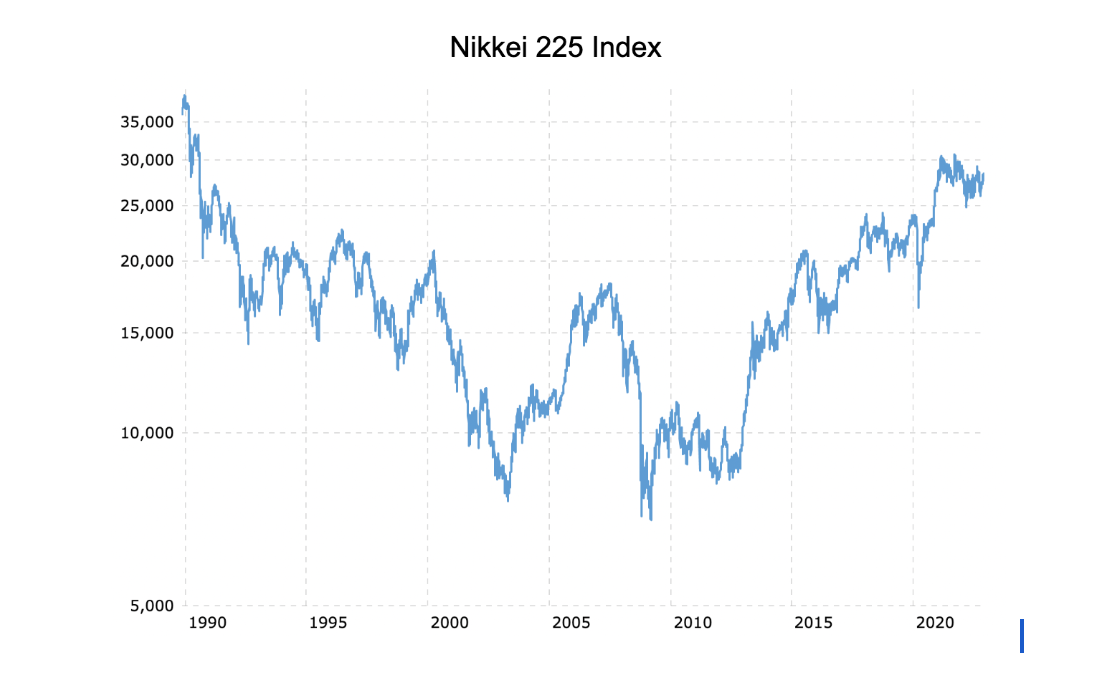
The U.S. stock market experiencing the same sort of debilitating blow is unlikely, but it’s never impossible. The truth is no one knows for sure what’s going to happen in the future. Investing in uncorrelated alternative assets is a forward-thinking strategy that helps to strengthen and protect a portfolio during a recession and during the recovery period that follows.
Alternative Assets in a Recession
Alternative asset investing can be particularly valuable in an economic downturn thanks to their lack of correlation with the stock market. Each alternative investment has its own advantages, and each will perform differently in a recession. Certain alternative assets in particular have strong track records of successfully weathering recent economic downturns.
Gold and wine are two such examples. Looking at the 2007-2009 Great Recession, the value of gold rose 26% as the S&P 500 dropped almost 57%. In that same period, the Liv-ex Fine Wine 1000 Index increased by 25%. Similarly, the S&P 500 fell 49% following the dot-com bubble while gold saw an increase of 12.4% and the Liv-Ex Fine Wine 50 Index (the only Liv-ex fine wine index at the time) appreciated 17%.
Alternative assets are a proven tactic for investors looking to protect their portfolios in a recession. What about online businesses in particular?
WebStreet and the Benefits of Online Businesses in a Recession
WebStreet has been in operation for only two years, and we don’t have the same level of historical data to compare. However, we can take a look at WebStreet’s performance data to date as well as the unique advantages to investing in online businesses in a recession.
WebStreet Funds On-Track for 20% Annual Returns
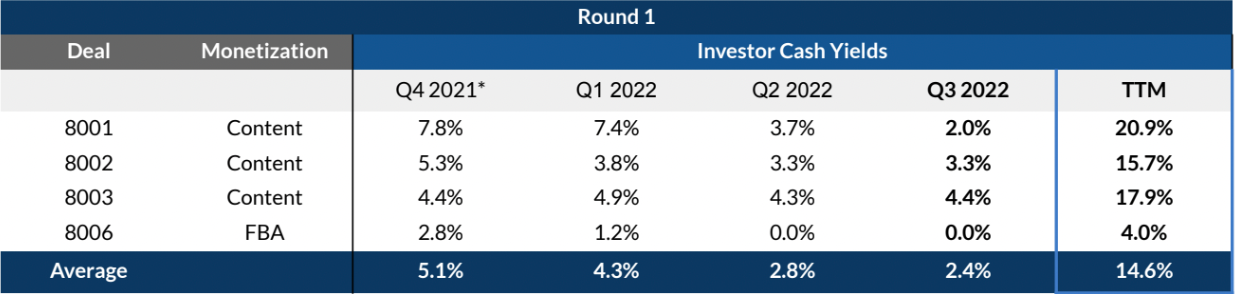
WebStreet investments are cash-flowing, with investors receiving consistent quarterly returns as well as capital gains earned at the time of exit. Round 1 has completed one full year under portfolio manager control, with WebStreet online business investors receiving 14.6% in annualized cash returns. This puts our Round 1 investors on track for a 20% internal rate of return once factoring in expected profits from the exit.
WebStreet is performing very well to date and continues to generate positive momentum, and online businesses as an alternative asset have some particular advantages to offer to investors looking for strong investment opportunities amidst an economic downturn.
Advantages To Investing in Online Businesses
Diversifying Your Portfolio
Rule #1 for a smart investing strategy is to avoid placing all of your eggs in one basket. Diversifying your portfolio – specifically with uncorrelated assets – means that while some of your investments may plummet, others can keep you afloat. Exploring alternative asset classes outside of traditional investing offers great opportunities for investors looking to diversify their portfolio and protect against losses by mitigating risk.
The WebStreet model not only allows investors to diversify their investment portfolio by adding online businesses as an alternative asset, but it allows for diversification within the platform itself. WebStreet investors are encouraged to invest in multiple funds with different monetizations, portfolio managers, and strategies to even further diversify – and therefore strengthen – their investment portfolio.
Capitalizing on the Opportunity of a Recessionary Environment
Investor returns for online businesses are impacted by three main variables: the purchase multiple, the performance of the portfolio, and the exit multiple.
The value of an online business is typically achieved by multiplying the average monthly profit of that business with a determined multiple. A downturn in the overall macroeconomic environment causes those multiples to decrease, allowing our portfolio managers to purchase quality online businesses for less than they would typically cost. A recession creates a disconnect between the true value of the business versus what they’re selling for, which translates to an opportunity for WebStreet portfolio managers and investors.
Recessions since the mid-20th century last an average of 10 months, whereas the expected hold period for WebStreet investments is 2-4 years. While online businesses are not immune to the challenges brought on by a recession, they can capitalize greatly on the period of expansion that typically follows. Taking advantage of factors like decreased competition and lower operating costs, online businesses have the opportunity to experience a tidal wave of growth moving out of a recession, resulting in higher investor returns.
When the recession has passed and it’s time to sell those businesses, investors will benefit from increased exit multiples. If market prices for online businesses are temporarily below where they should be at the intended time of sale, returns can be optimized by holding those businesses and exiting only once multiples have recovered.
Benefiting From the Recession-Resistant Properties of Online Businesses
Online businesses are unique in that they function completely on the internet, which gives them a particular advantage in times of recession. The ability to forgo a physical storefront or headquarters allows online businesses to operate with very low overhead costs while also having the unique ability to operate with little to no staff. That lowered overhead provides these businesses with more agility, making it easier for them to adapt to the changes brought on by a recession.
Certain online business monetizations are particularly well-suited to weathering a recessionary environment. Content sites and Kindle Direct Publishing businesses, for example, operate without having to carry inventory. Inventory control is a common hurdle faced by businesses in a recession, causing them to run into problems like excess inventory, stock shortages, and carrying costs. Not having to deal with these problems at all is a big advantage for certain online businesses.
Remember that e-commerce boom we mentioned earlier? The increasing popularity of online shopping and the growth of the e-commerce industry is significant, particularly as the economy takes a dip. It’s true that consumer spending drops in a recession. However, the upward trajectory of the e-commerce industry as a whole works to offset that drop in spending, making e-commerce another monetization with a particular advantage in a recession.
These capabilities are fairly unique to online businesses, and they can be huge factors when weathering an economic downturn. By investing in assets with recession-resistant properties, investors can continue to grow their wealth despite the challenges of a recessionary environment.
Why WebStreet Is the Best Way To Invest in Online Businesses
WebStreet is the first platform of its kind, offering a completely passive investment opportunity in the realm of online businesses. The portfolio managers are responsible for the active management of the assets, while investors simply collect returns.
For a detailed look into the WebStreet concept and structure, please take a look at our WebStreet Announcement (formerly EFC) and FAQ.
Here are some advantages to investing with WebStreet:
Making Informed Choices
Investors with WebStreet don’t invest in specific businesses but rather in funds run by specific portfolio managers. Portfolio Managers undergo an extensive vetting process before being approved, and investors can consult in-depth information regarding each portfolio manager’s background and track record. Investors can also review a portfolio manager’s detailed growth strategies and investment summaries for a specific fund before they invest.
Investors with WebStreet have access to far more information regarding growth strategies for the assets compared to traditional stock investing. They also receive detailed quarterly reports regarding asset performance.
Aligned Incentives
WebStreet has a stake in the arrangement. Everyone’s interests are aligned, with portfolio managers and WebStreet only seeing returns if the businesses are successful – just like investors.
The profit split of WebStreet fund is as follows:
- 66.7% to investors
- 33.3% carried interest
- 20% to portfolio managers
- 10% to WebStreet
- 3.3% to independent advisors
It’s in everyone’s best interest for the businesses to thrive. Should a particular fund begin to underperform, WebStreet works directly with the portfolio manager to build and implement a plan for improvement.
Convinced? Join the waitlist for investing in WebStreet’s Round 5 Now
The WebStreet model is producing strong investor returns to date, and this is just the beginning. Of course no investment is without risk, and online businesses can be volatile. That being said, investing in online businesses in a recession can be a forward-thinking strategy for capitalizing on macroeconomic conditions while diversifying and strengthening your investment portfolio.
Click Here To Start Your Journey With WebStreet Today. Unlock the door to diversified, alternative investments and learn more about investing in online businesses by reading our insights.